Fracture Knight
Fracture Knight is an interactive narrative adventure of exploration and puzzles, inspired by Costa Rican literature. A robot knight travels through pre-rendered, hand-painted 3D worlds populated by strange mechanical creatures, rendered in real time with custom shaders in Unity.
- Genre: Interactive narrative / exploration adventure
- Inspirations: Grim Fandango, Resident Evil (pre-rendered backgrounds), and the art of Wayne Barlowe, Robert Valley and Scott Robertson
- Technique: Pre-rendered backgrounds with real-time characters (Unity 3D)
- Target audience: Ages 22 to 35
Authors: Marco Antonio Cersosimo Bogantes · Juan Navarro · Luis Miguel Rojas Gondonneau
Fracture Knight is an interactive narrative game of exploration inspired by Costa Rican literature, the novel “Viaje al Reino de los Deseos”. It began as a graduation project at Veritas University’s School of Digital Animation, created by Marco Antonio Cersosimo Bogantes, Juan Navarro and Luis Miguel Rojas Gondonneau.
Why this game?
- An opportunity to create and tell stories inspired by Costa Rican literature.
- Applying digital animation knowledge and linking it with programming.
- A genuine interest in making a video game.
Scope
- Four scenarios are designed, of which only the first is playable at this stage.
- Built with the pre-render technique: rendered backgrounds with real-time characters.
- Target audience: ages 22 to 35, who are most likely to have read the book that inspired the project.
Following Jesse Schell, games are the solution of problems through a playful approach, and a video game adds an electronic, technological element that is essential and unavoidable.
Interactivity is a communication process where non-linear messages are emitted and can be read asynchronously. It can be technology-based, community-based or collaboration-based.
Interactive stories let the audience take an active or partial part by exploring or modifying the narration. Fracture Knight is a linear interactive narrative of exploration. It uses the criteria of literary adaptation only as inspiration: the resulting work is a new, independent product that responds to its own medium, the video game.
- Grim Fandango – A 3D graphic adventure where the image defines how the scene looks, while the character is computer-generated.
- Resident Evil – A 3D action game by Shinji Mikami that uses a cinematic language for a story of horror and adventure.
- Wayne Barlowe – Fantastic creatures and patterns used as textures.
- Robert Valley – Distorted perspectives and strong contrast.
- Scott Robertson – Sharp shapes and fragmentation.
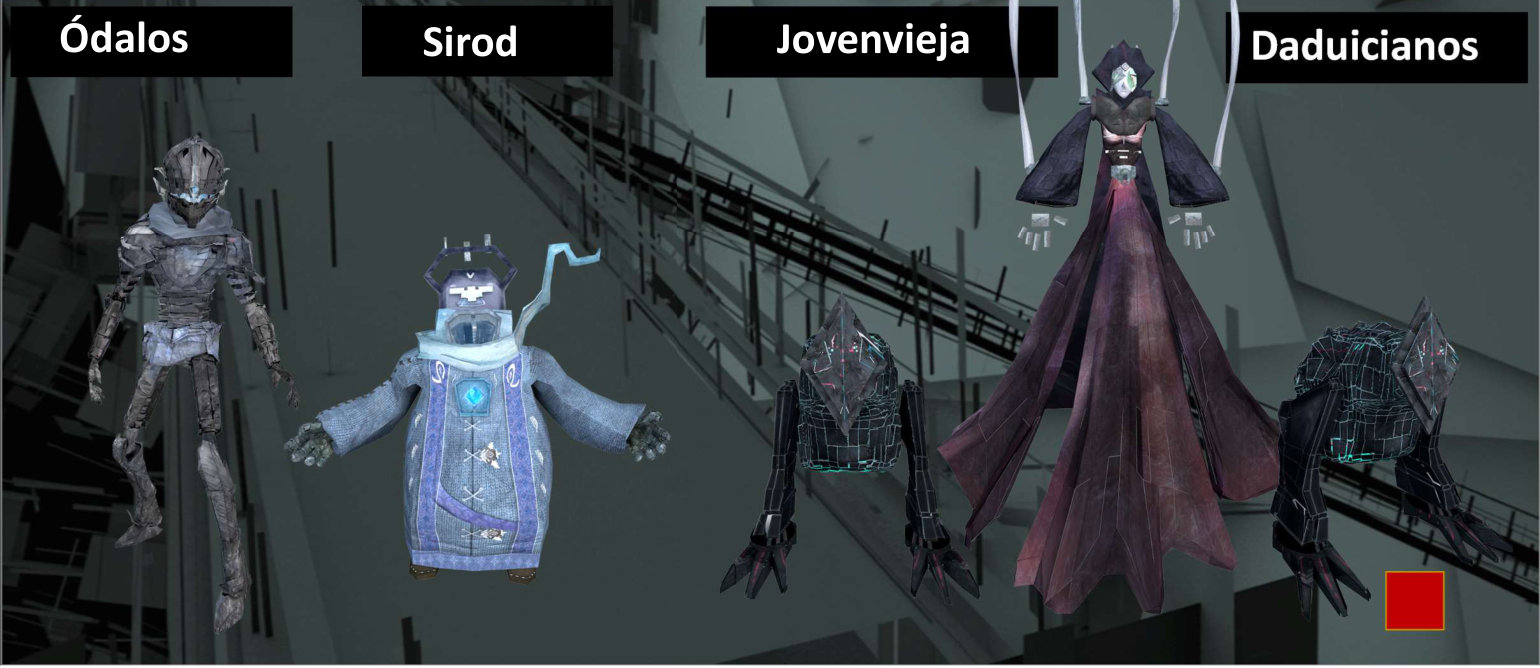
- Ódalos – The main character, a robot and medieval knight.
- Jovenvieja – The antagonist: a threatening figure of power, in neutral colors.
- Sirod – Provides guidance and assistance. Mysterious yet friendly, in vivid colors.
- Daduicianos – Tertiary characters: submissive mechanical creatures in vivid colors.
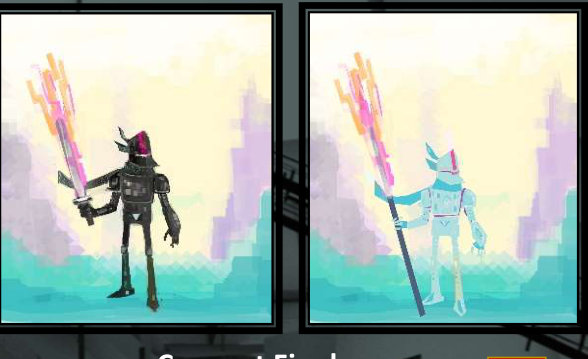
Character pipeline
Modeling in Autodesk Maya, geometry modification in Cinema 4D, texturing in Autodesk Mudbox, rigging in Blender 3D, motion-capture animation with Adobe Mixamo and the CMU MoCap Lab library, and materials in Unity 3D.
Each scene gets a unique treatment. The process: layout in Blender, final modeling and rendering in Cinema 4D, digital painting in Adobe Photoshop (texture work, retouching, blur, glow and shadows), and background assembly in Unity 3D. Invisible collision geometry delimits where the main character can walk, which is key for game and level planning.
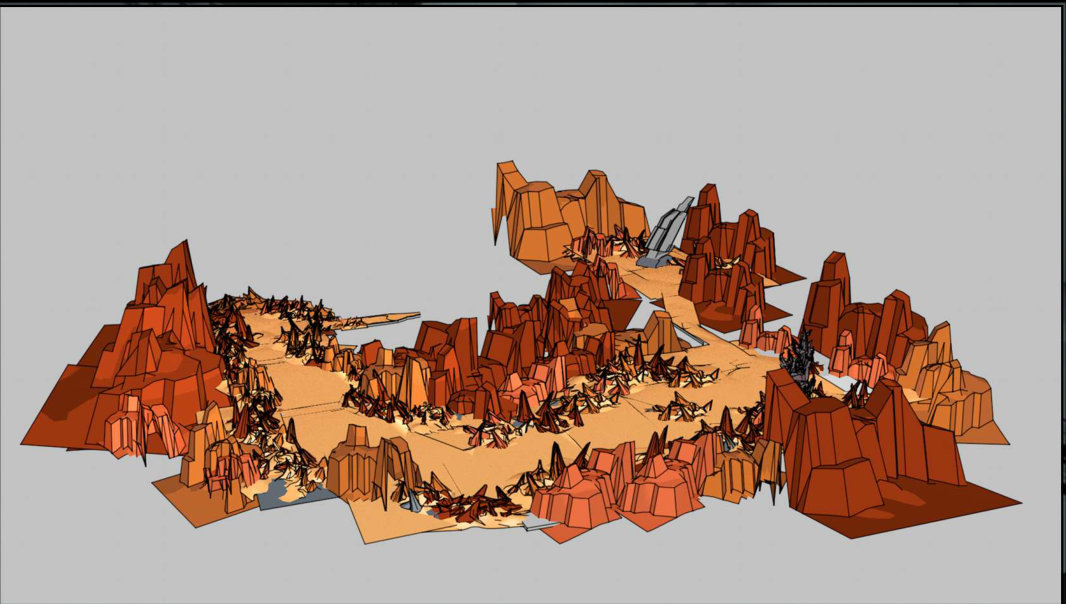
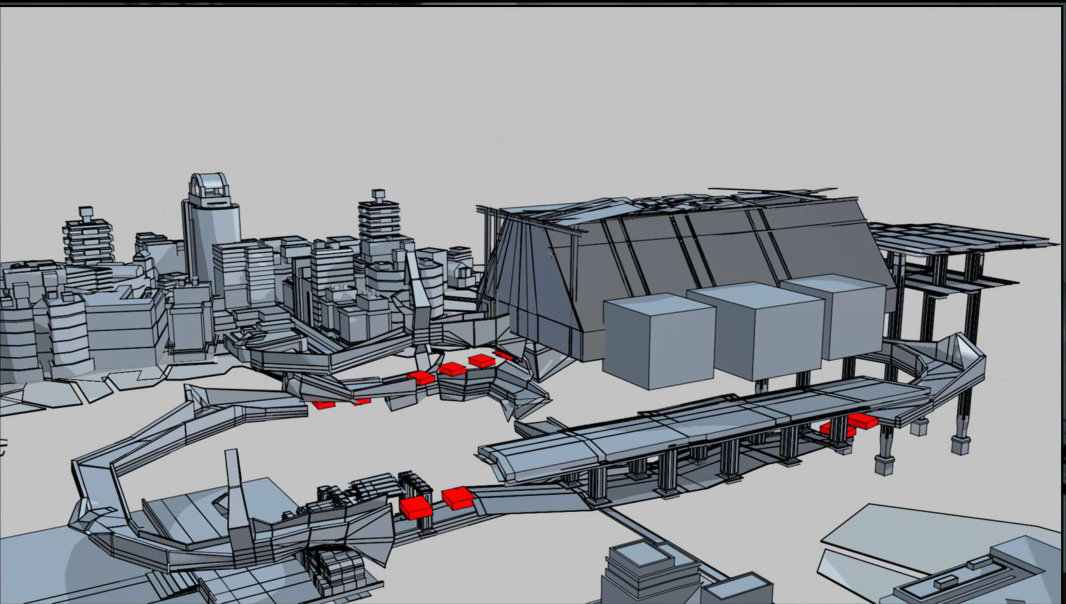
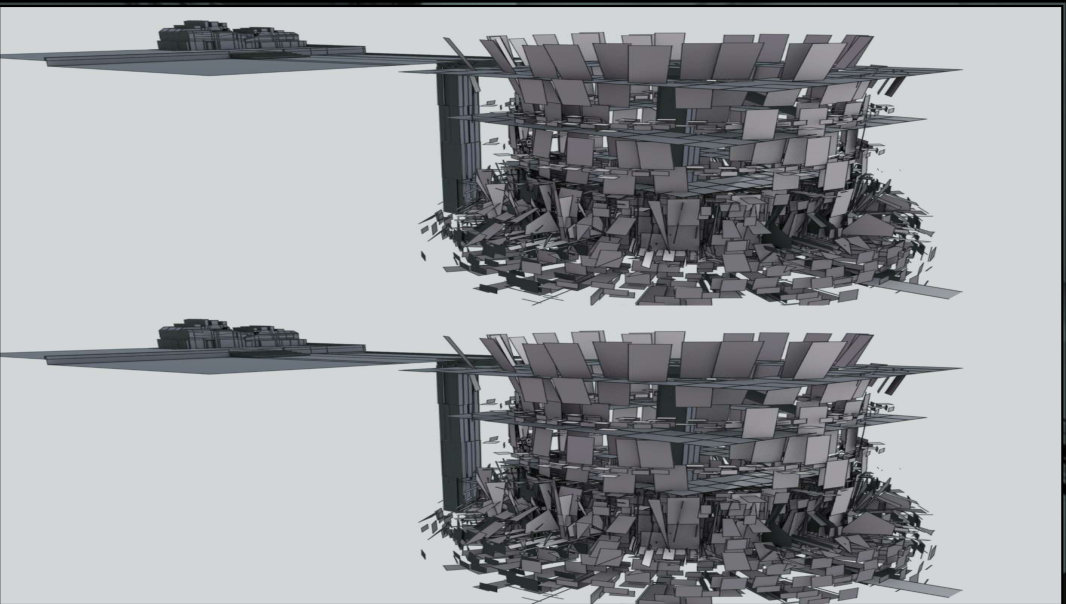
Scenarios: the Desert, Daduic, the Court, the Court Exit, the Tower Plaza and the Tower.
Puzzles determine the player’s tasks and reinforce the need to explore and read. The rewards are discovering the scenery and unlocking videos.
The user interface serves two purposes: showing information and acting as a tool for solving the game. Two interfaces were designed: a start menu to begin the game and a pause menu that tracks progress and gives hints. The menu went through many versions until it became a true help tool inside the game.
Script & dialogue. Multiple script versions were written: literary script, audiovisual script with event notes, column script and a flow diagram that structures events in stages of space and time. Dialogue was managed with Chat Mapper 1.9 (Urban Brain Studio).
Development follows the MSTA model: Mechanics, Story, Technology and Aesthetics. Each competence has its own role: the game designer for mechanics, the screenwriter for story, the developer for technology, and the visual designer and sound designer for aesthetics.
The team combined iterative development (weekly evaluations by goals, with leadership changing according to the objective) and spiral development (defining objectives, identifying risks, development and testing, and planning ahead).
Prototypes
Each prototype looked for new learning, because some ideas seem good until they are built. The path included a 2D animatic, a 3D concept test of a scene, motion capture on a skeleton with Autodesk HumanIK, a fixed camera with defined lens values, integration of the character with the background, and lighting prototypes with custom shaders and point lights affecting only the character.
Testing. Preliminary time-limited versions and unlisted online video recordings were given to selected people, with feedback gathered through surveys and interviews. It brought valuable design observations and technical fixes.
The game renders in real time at 60 frames per second. Unity’s built-in shaders did not meet the art direction, so we programmed our own:
- Shadow shader – Casts shadows from a directional light onto a transparent surface, a typical augmented reality problem.
- Occlusion shader – Masks the main character to tell apart background, middleground and foreground areas of a scene.
- Two-sided shader – Makes geometry visible from both faces, which is uncommon in games.
Real-time composition. Two cameras are composed in real time: camera 1 renders the background with an unlit shader, and camera 2 renders characters, masks, interactable objects and menus.
- The concept and development of a complete video game were achieved.
- Visual techniques and game-specific software were researched and tested.
- The challenges along the way became essential learning for our future work and art in digital animation.