Neon Atom Pulse

Neon Atom Pulse (N.A.P.) is a 2D platformer-shooter inspired by Capcom’s Mega Man X franchise. It does not aim to revolutionize or create a new genre, but to recreate an excellent title from the 16-bit era, with the speed, color and arcade feel of the classics and new mechanics that feel familiar.
- Status: In development
- Genre: Sidescroller platformer shooter
- Inspirations: Mega Man X4 (Capcom), Cave Story (Pixel), Hyper Light Drifter (Heart Machine)
- Setting: Far future. Humanity has ceased to exist and vegetation lives over the rubble.
- Look: 2D pixel-art sidescroller
Producer & Lead Designer: Kristoffer Vela · Art Direction: Kristoffer Vela · Programming: Juan Navarro, William Sibaja
N.A.P. does not tell its story directly. The narrative is cryptic: small hints in the art, background elements and random objects in the levels. There is no text and no voice acting, and players can interpret the story as they like or ignore it entirely.
In the year 2401, an android is reactivated in a world where corrupted machines are slowly destroying the planet.
The world is a far future where humanity no longer exists. Centuries have passed since the last sign of civilization; ruined cities are covered by vegetation that has grown back. In an underground ruin an unauthorized intrusion triggers the alarms and activates a defense system of 7 androids, of which only one was successfully preserved.
Null, the protagonist, wakes from stasis with fragmented memory and no purpose. Unlike the machines, Null has artificial intelligence. A defensive android with great mobility, Null carries two light sabers on the back. After escaping the ruins, Null finds a green, colorful world, while factories in the distance keep polluting and destroying it. Attacked by machines for reasons unknown, Null sets out to learn about this world, who the machines are, and what connects the two.
The explorable area is only a small portion of a larger world, with seven defined sections protected by six major machines.
- Un – Heavy-equipment machine specialized in brute-force demolition, with hydraulic hammers for arms. Lives in the Old Capital.
- Duo – Engineering machine that designs and produces smaller maintenance machines at the Power Plant.
- Tre – Drilling machine that excavates raw materials for new machines. Found in the Old Mines.
- Vier – Demolition machine specialized in fire, burning forests to make room for new factories. Lives in the Old Forest.
- Cinq – Weather-control machine that keeps the climate optimal for the factories. Guards the Peak of Death.
- Sei – Waste-management machine where failed machines are sent and reused, at the Waste Center.
Heavily influenced by the Mega Man franchise, N.A.P. keeps its core mechanics simple, while new mechanics give it its own identity. The player generally travels from left to right, and the goal of every stage is to reach the last room and defeat the stage's major enemy, which grants Null new attacks and abilities.
Movement
- Walk / Run – Subtle friction for visual fluidity and precision in small movements.
- Jump – Sensitive to button press time, with immediate start, brief hang time at the apex and accelerating fall.
- Dash – A fast forward burst for crossing distance or dodging; chain presses to remove the distance limit. Usable once in the air.
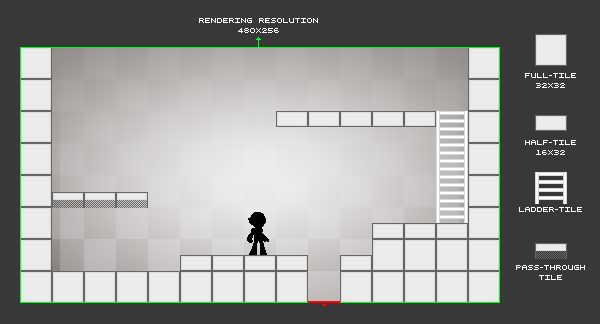
- Ladders – Climb obstacles that cannot be jumped over.
- Wall jump – Certain walls provide an extra jump point or an evasive tactic.
Basic abilities
- Attack – A light-saber 3-hit combo on the ground, plus weaker infinite attacks in the air and on walls.
- Counter – A quick move that deals no damage but stuns melee enemies for one second (not projectiles).
Additional abilities (won from major enemies)
- Hammer Hand – Powerful metal-fist attack; Null does not lose balance when hit while attacking.
- Lightning Bolt – A directional lightning dash that can stun certain enemies, also usable in the air.
- Drill Spin – Omnidirectional aerial area attack that also enables a double jump.
- Fire Uppercut – A higher, fire-powered jump attack.
- Diamond Dive – A fast aerial descent creating crystals that can freeze enemies and explode on impact.
- Acid Blade – Passively strengthens the light sabers.
- Ground enemies – Walk, run or jump; either aggressive (constantly attacking) or passive (evading or attacking only when provoked).
- Air enemies – Constantly airborne; aggressive ones chase and shoot, passive ones hover in place or patrol to block the way.
- Wall enemies – Stuck to walls, attacking or simply blocking the path.
- Major enemies – Always in the last room, with their own 32-point energy bar and a specific weakness. Defeating one grants a new ability.
Level hazards:
- Spikes, bottomless pits and crushers: instant death.
- Pendulums: 8 energy points lost and knockback in the direction of impact.
Null has 32 energy points. Enemy attacks fall into four types: Low (1–3 points, small projectiles), Medium (3–8, large projectiles, melee), High (8–16, large visual attacks) and Extra (16+, special attacks that kill or leave Null at 1 point). Each reacts differently: Low only flashes the sprite; Medium interrupts movement for about half a second with a 32 px knockback; High doubles the stun and increases knockback to about 90 px.
Atoms dropped by enemies (1–3 each) level Null up to 3 times (10 Atoms per level), softening the damage penalties and increasing attack power by 5% and 10%. Levels are dynamic and are lost when Null is hit.
- Energy orbs – Small restore 6 points, large restore 16; they vanish after 4 seconds.
- Energy tanks – Large tanks give full energy on demand; two small tanks combine into one large.
- Atoms – Bounce off floors and walls and vanish after 2 seconds.
There are 11 stages: a mandatory introduction and tutorial stage, then 6 stages playable in any order, and finally 4 linear stages that require every ability. Major-enemy weaknesses follow the chain Lightning → Hammer → Fire → Diamond → Drill → Acid, are never required to finish a stage, and also unlock secret areas. Checkpoints are invisible, and progress is saved after each stage.
- Introduction – Underground ruins and a laboratory ending at the exit to the outside world.
- Old Capital – An abandoned skyscraper city ruled by vegetation, climbing to the highest tower.
- Dark Forest – A lush forest and abandoned caverns slowly consumed by fire.
- Peak of Death – A snowy mountain with random storms, ending at a climate research building.
- Old Mines – Crystal mines with heavy machinery and frozen underground rivers.
- Power Plant – Vertical industrial stage with electrical storms and smog.
- Waste Center – From underground waste aqueducts to the main processing complex, with toxic green smoke.
- Old Factory – The final area, from the fortress exterior through research labs to its highest point.
Every stage has elements that pulse to the rhythm of its music: dancing fire, flickering lights and moving machinery.
Camera. Smooth transitions between rooms, with invisible “Camera Stoppers” that limit movement so stages can be condensed into small areas. Four behaviors: Tunnel (horizontal), Tower (vertical), Open (free) and Closed (a single room). In horizontal scrolling the player is placed in the second quarter of the screen rather than centered, giving more reaction space ahead.
Interface. Minimalist and free of visual noise. The game opens with warning, controller-recommendation and developer screens, then the title and main menu (Start Game, Options, Credits, Quit). The only on-screen text is “READY” at the start of a stage and “CAUTION” before a major enemy. The Start button opens a menu where acquired abilities can be turned on and off.
Controls. A default control scheme is provided, and the player can remap the controls freely.
Sound. Effects similar in quality to a 4th-generation 16-bit console. Music. Melodic, optimistic and urgent despite a darker story, with fifth-generation console quality rather than chiptune; Mega Man X4 is the main inspiration.
Art. Modernized 2D pixel art: extremely colorful, with toxic and neon colors, clean solid color blocks and fluid animation. Lights are circular gradients that blend with the art without casting shadows. With no text or video to tell the story, the art itself hints at it through objects and backgrounds.
Technology requirements. A pure 2D engine with at least 6 parallax layers, blend modes (Overlay, Multiply, Soft Light), a music spectrum analyzer to sync objects to the beat, 60 FPS even on low-cost hardware, a 2D particle system, and pixel-perfect rendering at 480×256 (an 8×15 grid of 32×32 tiles).
Target audience & distribution. PC as the main platform on stores such as Steam, GOG and Humble Store, with consoles and mobile considered but not a priority. The game targets players nostalgic for 8- and 16-bit 2D platformers and players looking for an accessible game with a pleasant challenge, as a global product with no specific region or community.